What a sewer line replacement costs in Chicago
Ask what a sewer line replacement costs in Chicago and every answer you get will be somebody's average. This is what public bodies in this county actually publish, what none of them publish, and what decides the number on your own lot.
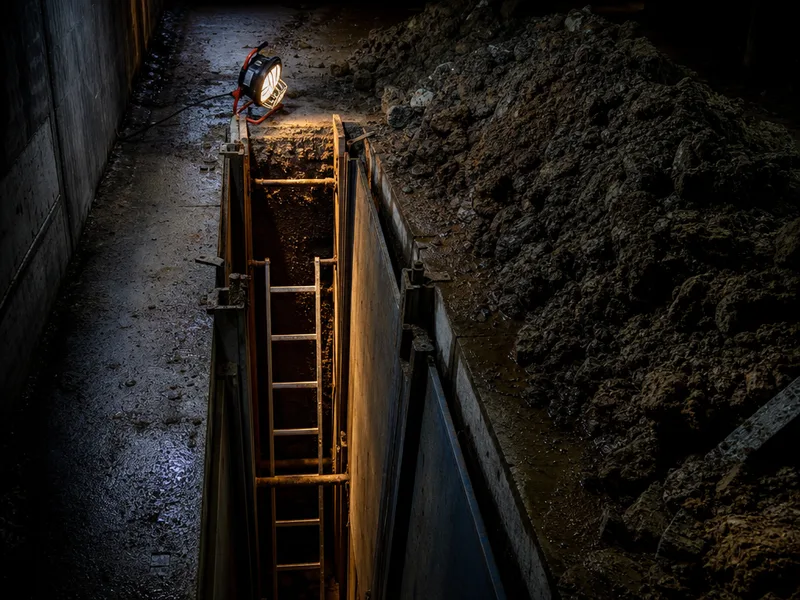
There is no honest single answer to what a sewer line replacement costs in Chicago, and the reason is not modesty. The four things that decide it are all invisible from the street: how deep the line sits, what is built on top of it, what the pipe is made of, and which side of the city sidewalk it failed on.
So this page collects the figures that public bodies here have actually put their name to, and says what to do with the ones that come from anywhere else.
How much does it cost to replace a sewer line in Chicago?
No figure on this page is ours. Nothing has been built here to average, and an invented range would tell you only what we guessed.
The figures that do exist are in the table below, and each is narrower than a headline range. The City publishes one, for a specific stretch of pipe under the road. A village in this county publishes what it will contribute toward one kind of repair, and what it requires in return. The City publishes the fee for the license that has to sit behind the permit. Between them they describe the edges of this trade rather than its middle.
For the middle, the usable answer is not a number at all. It is the short list of things that decide yours.
What is the average cost to replace a sewer line in Chicago?
An average across this city's housing stock would be close to meaningless, and the reason is specific to Chicago rather than general.
Chicago laterals were laid across roughly a century of different practice, into lots of very different depths, under buildings whose basements were finished at very different times. A vitrified clay line four feet down in an open side yard and a cast iron line nine feet down under a poured slab are the same item on a price list and two completely different days of work. Averaging them produces a number that is wrong for both, and it is wrong in the direction that suits whoever published it.
That is the real problem with the ranges in circulation. Most of them are national figures adjusted by a metro multiplier, and the multiplier does not know about your parkway tree.
What moves the number on a Chicago sewer job
Five things, roughly in the order they matter.
Depth, then length. Depth sets how much ground has to be held open and shored at each access point, and it climbs faster than footage does. A run that needs a deep receiving pit at the parkway end is a different job from one that does not, even where the pipe between them is identical.
What is sitting on top of the run. This is the variable that decides whether trenchless saves you anything at all. A public walk, a driveway, a mature parkway tree or a finished basement floor all cost real money to open and put back, and the saving on a trenchless sewer repair in Chicago is the ground nobody has to restore. Across an open lawn the arithmetic is much closer.
What the pipe is and how it failed. Clay that has cracked but held its round shape is the cheapest kind of bad news, because a cured in place liner can be installed through a cleanout that already exists. Orangeburg that has gone oval, or a line that has collapsed, rules lining out and puts you into pipe bursting or a dig at the failed length. The video settles which of those it is, and the quote does not.
Where the work can start and stop. A basement cleanout in a reachable spot is worth a surprising amount of money. Where there is no usable cleanout, one has to be made before anything else happens, and where a pit would have to be sunk through a slab or beside a structure, the cheap end of the job disappears.
Which side of the sidewalk the defect is on. For a residence of up to four units, a break proven to be under the public way may be repaired by the City at no cost to the owner. That does not make the rest of the line cheaper, but it can remove a whole segment from what you are being quoted for, so it pays to know before the quote is written rather than after.
What the price usually leaves out
There is a second bill after the first one, and it is small, annoying and almost never quoted.
Ground that has been opened settles. The excavated soil goes back looser than it came out, rain works it down over a season or two, and the parkway or the lawn above a repair sinks. Whose job it is to deal with that is worth settling in advance, because at least one public body in this county has already answered it in writing. River Forest, running its own lateral reimbursement program, tells participating owners plainly that restoring or replacing the landscaping in the parkway is theirs, and so is correcting subsidence in the excavated area, including any future filling and reseeding. A village will pay half of a five figure repair and still hand back the topsoil.
Take that as the benchmark rather than as one village's meanness. If a program written to help homeowners draws the line there, a private quote is unlikely to be more generous by accident, and the honest thing to do is ask where it draws the same line.
The other omission is seasonal, and it belongs to this city specifically. Ground that is frozen is harder and slower to open, and pavement and concrete work mostly stops for the winter here, so a January break can mean an excavation backfilled and plated in one month and finished properly in another. Nothing about that is unusual and none of it is free. It is a fair question to ask in December and a pointless one to ask in June.
Finally, ask what happens inside the building. A pit sunk through a basement slab leaves a slab to repour, and cleaning up after a backup that has already happened is separate work from stopping the next one.
Why nobody publishes a Chicago number
It is a fair question, and the answer explains most of what is wrong with the figures you can find.
Almost everyone with the data has a reason not to publish it plainly. Contractors price jobs individually and a published range becomes a ceiling in every negotiation that follows. The cost aggregators that rank for these searches are selling introductions to those contractors, so their ranges are wide enough to be unfalsifiable and are usually national numbers wearing a city name. And public bodies publish only what they are prepared to be held to, which is why the City's figure is attached to one narrow kind of repair and the village's is a cap on its own contribution rather than an estimate of anybody's bill.
The most quoted price anchor in this market is not a publisher at all. It is a thread on a Chicago message board whose title asks whether ten to twenty thousand dollars is normal for forty feet of basement sewer line, and it has sat at or near the top of these search results for a long time. It is real evidence that people here are being quoted figures of that shape and cannot tell whether they are reasonable. It is not a source, and we are not going to launder it into one by repeating the number with our name under it.
What that leaves is unsatisfying in the abstract and perfectly workable in practice. Get the line filmed. Get the defect located to a distance along the run. Get estimates that state where the priced pipe starts and stops. Then the three numbers in front of you are comparable, which is more than any published range can do for you.
The methods those estimates will name are set out under sewer line repair in Chicago, and what the City may take off the end of the bill is in the guide to the Chicago private drain program.
Every figure a public body around here actually publishes
Every one of these is narrower than it first looks. The scope column is the part that matters, and it is the part a headline range leaves out.
| The figure | What it actually covers | Published by |
|---|---|---|
| Between $5,000 and $10,000 | The City's published figure for the public-way repairs its private drain program now covers, on a 311 article dated December 12, 2018. It describes one stretch of pipe under the road and it is not a general Chicago replacement range | City of Chicago 311, Private drains program overview |
| A 50% match, up to $7,500.00 per property | What one Cook County village, River Forest, will reimburse for structural sewer lateral damage repaired within the limits of the roadway. Repairs beyond the roadway are the owner's in full, and each property gets one reimbursement | Village of River Forest, Sewer Lateral Repair Reimbursement Program |
| At least three estimates | What that same village requires a homeowner to obtain before it will approve a reimbursement, alongside a three-year warranty on all labor and materials and a detailed cost proposal itemising every element of the work | Village of River Forest, Sewer Lateral Repair Reimbursement Program |
| Parkway landscaping and later settlement | Left with the property owner even inside that reimbursement program, along with any future filling and reseeding once the excavated ground subsides. Settling of excavated soils is described as common | Village of River Forest, Sewer Lateral Repair Reimbursement Program |
| $125 | The fee for the Chicago drainlayer license, which the City issues only to applicants who are bonded and insured, and without which nobody can pull the sewer permit your job needs | City of Chicago, Drainlayers License |
River Forest also writes down what counts as structural damage, which almost nobody does: a missing section of pipe no less than 5 square inches, or joints separated by more than 1 inch. That is a village setting a threshold for its own money, not a national standard, but it is a written benchmark you can hold a video against, and it is more than the trade generally offers.
Questions worth asking before you compare two sewer quotes
- Does a longer sewer line always cost more to replace?
Length matters less than most people expect and depth matters more. Sixty feet of pipe four feet down under an open side lawn is a straightforward job. Thirty feet nine feet down under a finished basement slab, with a walk and a parkway tree over the far end, is not. Ask what the video showed for depth and where the run actually starts, because those two numbers move a bill further than the footage does.
- Why is one quote half the price of another for the same house?
Usually because the two are not for the same length of pipe. One may stop at the property line and the other carry on to the connection at the main; one may include putting the walk and the parkway back and the other leave it as a note. Neither is dishonest, and comparing them as numbers alone tells you nothing. Get both to state where the priced run starts, where it stops, and what is put back afterwards.
- Should I get more than one estimate?
Yes, and there is a local precedent for how many. River Forest requires a homeowner to obtain at least three before it will reimburse anything under its own lateral program, and to submit a detailed proposal itemising each element. A village applying that standard to its own money is a reasonable standard to apply to yours.
- How much do the permits add?
Less than people fear, and they change who can bid more than they change the total. The Chicago drainlayer license is $125 and its holder has to be bonded and insured, and sewer permits go only to drainlayers, so the permit layer narrows the field of contractors before it touches the bill. The rules around it are set out in the guide to the private drain program, including the 20 foot in-kind replacement that can be permitted after the fact.
- Will the City pay for any of my sewer line?
Possibly the last stretch of it, and nothing else. Chicago may repair a private drain broken under the public way for a residence of up to four units at no cost to the owner, on published conditions. It never reduces the cost of the pipe on your own property, so it is a subtraction from one end of the bill rather than a discount on the job. The private drain program is written up in full.
- What has to happen before a price is worth anything?
The line has to be on video, with the footage counter running, and the defect has to have a distance against it. Everything above is background until that exists. A camera inspection is the cheap part of this trade and it decides the expensive part. Ask through this site and the address reaches a sewer contractor covering that area; the estimate is theirs, in writing, with the method named on it. Brokering that introduction is all this site does, which is the reason no number anywhere on the page is ours.
Get the number from the pipe, not from a page
No figure written on a website knows how deep your line is, what is sitting on top of it or where it failed. Give us the address and the year the building went up, and a sewer contractor prices the job against a camera run instead of against an average.
Free, written, and no obligation. We answer requests the same day.