Sewer line repair in Chicago, IL
Sewer line repair in Chicago usually comes down to one bad section of a clay or cast iron drain rather than the whole run. A camera tells you which it is, and that answer decides whether the fix is a spot repair, a liner, or a new pipe pulled through the old one.
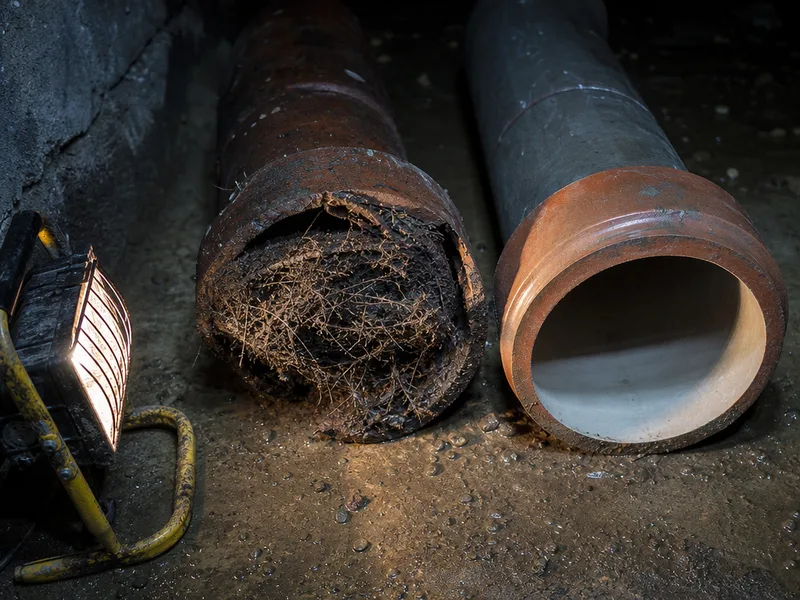
A Chicago sewer line is the private drain that starts under the basement floor, runs out through the front yard and the parkway, and ties into the City main under the street. Almost every call about sewer line repair in Chicago is about the middle of that run. How much of it has to be opened up is decided by what a camera finds, not by which method a contractor happens to sell.
What actually fails in a Chicago sewer line
Most of the housing stock here was plumbed with vitrified clay tile in short sections with mortared joints, and the joints are the weak point. Roots find them, the sections settle out of line with one another, and a pipe that was round in 1926 ends up with an offset every few feet. Cast iron under the slab rusts from the inside until the bottom of the pipe is gone. On post-war blocks the lateral may be Orangeburg, a rolled fiber pipe that goes oval under load long before it cracks.
Standing in the basement, none of those look any different from a blockage. That is the reason the camera run comes before the quote.
Sewer line repair or full sewer line replacement, and how the call gets made
There are four answers, and the pipe picks one of them.
- One break in an otherwise round pipe. A spot repair opens a single section, replaces it, and leaves the rest of the run alone.
- A long stretch of cracked but round pipe. A liner cures a new pipe inside the old one, end to end.
- A collapsed, crushed or badly offset line. There is nothing left to line, so a new pipe has to take its place.
- A line laid at the wrong fall. Neither trenchless method fixes this. Both follow the path already in the ground, so a sewer line that will not drain because of its slope has to be re-laid.
That last one is the answer nobody selling trenchless work volunteers, and it is why the camera comes before the number. A sewer line replacement quoted from a description of the symptoms is a guess with a price on it.
Signs the problem is the sewer line and not the fixture
One slow drain is a fixture. A sewer line announces itself in a pattern:
- More than one fixture backing up, usually the lowest ones first
- The basement floor drain surfacing when the washing machine empties
- Gurgling from a tub or a toilet while a different fixture is running
- A sewer smell in the yard or over the parkway after rain
- Soft ground, a dip in the lawn, or a settled square of sidewalk over the run
Chicago adds one of its own. A line that backs up only in heavy rain is often being overwhelmed from the street rather than blocked at the house, and that is a different problem with a different fix.
What the City pays for, and what it does not
The City runs a private drain program, and it changes the arithmetic on a repair enough that you want the detail before you accept any quote. Chicago may repair the section of a private drain broken under the public way, for buildings of up to four units, at no cost to the owner. The conditions are specific and they are in the table below. The same pipe between the building and the sidewalk is the owner's, whatever it costs.
Every contractor quoting a five-figure job has a reason to leave that boundary vague. It is drawn on our page about trenchless sewer repair in Chicago, and the process the City actually runs is set out in the guide to the Chicago private drain program.
"Sewer line replacement" in Chicago is two different searches
Type sewer line replacement chicago into Google and the first result is not about sewers at all. It is Lead-Safe Chicago's page on lead service line replacement, which is a City effort about drinking water.
The two pipes are unrelated.
A water service line brings water in. Lead-Safe Chicago describes it as the pipe that transports water from the water main in the street into the home. A sewer line takes waste out, from the house to the sewer main. They run through the same few feet of ground, they are replaced by different trades under different programs, and a house can badly need one while the other is fine.
If somebody quotes you for a "line replacement" with no word in front of it, ask which pipe they mean. On a block where the lead program is active, two crews may be working the same parkway in the same month, and the one that is free for you is not the one that fixes a backed-up floor drain.
The suburbs run on different rules again, because the private drain program stops at the city limits. Every village owns the boundary its own way, which is why sewer work in Oak Park and sewer work in Evanston get their own pages rather than a line in a coverage list.
Who pays for a broken sewer line in Chicago
The City of Chicago publishes all of this. Nothing in the table is our figure.
| What | What the City publishes | Published by |
|---|---|---|
| Buildings the private drain program covers | Residential properties of up to and including four units | City of Chicago, Private Drain Repair |
| Where the City may pay for the repair | The part of the drain broken under the public way, which the City defines as the area from the city sidewalk to the center of the street | City of Chicago, Private Drain Repair |
| What has to happen before the City will look | A licensed sewer contractor is hired to rod and/or make a video inspection of the drain line, and that contractor schedules a review by a City sewer inspector | City of Chicago, Private Drain Repair |
| What the City says a homeowner would otherwise pay | Between $5,000 and $10,000 for a repair in the public way | City of Chicago 311, Private drains program overview |
| What stays the homeowner's cost either way | Maintenance and rodding of the private drain | City of Chicago 311, Private drains program overview |
The City's two pages word the covered stretch differently. The program page describes it as the part of the drain under the public way, from the city sidewalk to the center of the street. The 311 overview describes the same program as covering the private drain from the main sewer to the property line. Both are the City's own wording, and the sewer inspector on site is who decides which side of the boundary a break falls on.
Sewer line repair questions Chicago homeowners ask
- What is the average cost to repair a sewer line?
We publish no price of our own. There is no job history here to average, and a made-up range helps nobody. The one Chicago figure published by a body you can check is the City's: its 311 overview of the private drain program says a homeowner could expect to pay between $5,000 and $10,000 for the kind of public-way repair the program now covers. Past that, cost tracks length, depth, what sits above the pipe, and whether the answer is one section or the whole run. Our guide to what sewer work costs in Chicago works through it.
- Who is responsible for a broken sewer pipe?
From the building out to the public way the drain is private, and the property owner pays for it. Under the public way the City may repair a drain serving a building of up to four units at no cost to the owner, on the conditions in the table above. The break has to be proven to be there first, which is why a sewer camera inspection is the first step rather than an upsell.
- Will homeowners insurance cover sewer line repair?
Read your own policy, and ask your insurer in writing. Homeowners cover is generally written around sudden accidental damage, and the failures that take out a Chicago sewer line are gradual ones: root intrusion at a joint, corrosion, forty years of settlement. Those are the usual exclusions. Some insurers sell a separate service line endorsement that changes the answer. Nobody on a contractor's website can tell you what your policy says.
- Is the City's lead pipe program the same thing as sewer line replacement?
No. They are different pipes. The lead program replaces the water service line, which Lead-Safe Chicago describes as the pipe that transports water from the water main in the street into the home. A sewer line carries waste the other way, out to the sewer main. A house can need one and not need the other. The section above is why the two get mixed up in search results.
- Can a broken sewer line be repaired without digging up the basement floor?
Often, and that is what trenchless methods are for. If the host pipe still holds its shape, a cured in place liner goes in through an existing cleanout. If the pipe is collapsed or undersized, pipe bursting pulls a new line along the old path from two small pits. What neither method fixes is a line laid at the wrong fall, because both of them follow the path already in the ground.
- How do I get a sewer line repair estimate in Chicago?
Send the property address, what the fixtures are doing, and the age of the building if you know it. Photographs of the floor drain and the cleanout are worth more than a description. What comes back is a written estimate covering the camera run and the likely repair, and the number firms up once there is video of the pipe. The estimate costs nothing and books nothing.
Find the break before anyone prices the repair
Send the address and what the drain is doing. A camera run comes first, so the number you get back is for the break that is actually there rather than for the worst case.
Free, written, and no obligation. We answer requests the same day.