Trenchless sewer repair in Elmhurst, IL
Elmhurst homeowners are on a sanitary system that is kept separate from the storm system and that ends at a treatment plant the City runs itself. Trenchless sewer repair in Elmhurst is judged against that: a cracked lateral here leaks clear water into a system the City itself pays to treat, on top of whatever it is doing to your drains.
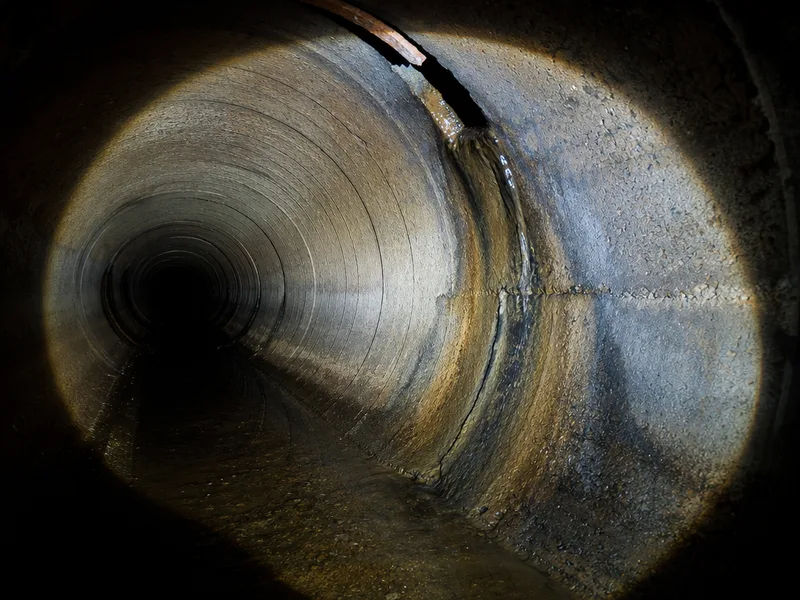
Elmhurst is the outlier on this site, and the reason is under the street rather than in an ordinance. It is a DuPage County city that runs its own sanitary sewer system, keeps it separate from its storm system, and treats its own wastewater at its own plant. Everything about a sewer problem here follows from those three facts.
The four suburbs on the Cook County side of this site sit on combined sewers, or partly combined ones, feeding regional infrastructure. Elmhurst does not work that way, and a homeowner who moved here from the city is often applying the wrong mental model to their own drain.
Two separate networks, and one plant at the end of one of them
The City publishes what it operates. On the sanitary side that is 144 miles of collection system, 3,700 manholes, 10 lift stations and force mains, 6 flow monitoring devices and 12 emergency sanitary overflow locations, ending at an activated sludge wastewater treatment facility described as 8 million gallons per day with a peak of 79. On the storm side it is a separate 133 miles of pipe with more than 60 outfalls and flap gates discharging into local streams, moved along by 18 stormwater pumping stations.
Two networks, two jobs. Rain is supposed to go to the creeks. Sewage is supposed to go to the plant. Anything that crosses from one to the other creates a problem for somebody, and in a city that owns the plant, the cost of the crossing lands locally.
The two capacity figures the City publishes for its plant are worth sitting with for a moment. It is described as an 8 million gallon per day facility that peaks at 79. Sanitary flow from a fixed number of houses and businesses does not multiply by ten in a storm, because the same people are using the same toilets. Something else is arriving, and in a separated system that something is rain and groundwater finding its way into sanitary pipes through defects, wrong connections and open joints. The City also lists 12 emergency sanitary overflow locations, which is what a system carries for the hours when arriving flow beats what can be moved and treated.
Which is why the City checks your sump pump before you can sell
Elmhurst requires a sump pump inspection, in compliance with section 7 Article V of the Municipal Code, before transfer stamps are issued for a closing. The requirement applies to every property in the city, residential and commercial, with limited exceptions for condominium complexes. An approved inspection lasts six months, a failed one has to be corrected and re-inspected, and the City states outright that it will not accept a legal letter in place of a pass and that there are no exceptions.
The checks themselves read like a list of the ways the two systems get mixed up. The pit needs a cover. Nothing but stormwater may drain into the storm pit, so no bathroom, washing machine or utility sink into it. A sump discharging overland has to go to the middle of the front or back of the lot rather than onto a neighbor, a sidewalk or the parkway. And a sump that drains underground must be connected to the city storm sewer, not the sanitary, because the City treats a sanitary connection as an illegal connection.
If you are selling here, that inspection sits on the critical path of the sale, and the City's own advice is to book it at least two weeks before closing because slots fill.
What separated sewers change about a cracked lateral
On a combined system a leaking joint is mostly your problem: it lets roots in, it collects debris, and eventually it blocks. On a separated system the same joint has a second effect. Groundwater enters the sanitary line through it and travels to a plant that has to treat it as though it were sewage.
That is why a backup is not the only failure worth taking seriously here. A line that runs wet with clear water when no fixture is in use, or a basement that smells of damp rather than of drain, can be a lateral taking water in rather than pushing waste out. Rodding does nothing about it, because there is nothing blocking the pipe.
Sewer pipe lining is the method aimed squarely at that fault. Curing a new pipe inside the existing one closes the joints and the fractures along the whole lined length, which stops infiltration as a side effect of restoring the pipe. Where the line has lost its shape entirely, that is instead a case for pipe bursting, and where one hub has failed in an otherwise sound run it is sewer line repair on that section. The comparison between all four options sits on the services page.
Getting the diagnosis in the right order
Nothing above can be decided from the basement floor, and the order that saves money is the same one this site recommends everywhere. Put a camera in the line first, get the recording, and get the footage reading for anything the camera finds.
A sewer camera inspection is the only thing that separates a blockage from a structural defect, and in Elmhurst it also answers the question the City's inspection raises from the other direction. A homeowner who has just been told their sump discharge is wrong usually wants to know what else about their below-grade plumbing was assumed rather than checked.
Ask for three things when you book it: the video file, a written statement of what was found, and the distance along the run at which each item appears. A summary without distances is an opinion, and it cannot be compared with the next recording somebody makes of the same pipe.
How Elmhurst compares with the suburbs east of it
Distance is a poor guide to what applies to your address. Elmhurst is under eight miles from Oak Park, whose code stops the owner's responsibility at the curb line, and under nine from Berwyn, which since 2025 has required video of the whole lateral before a certificate of compliance on an investment property transfer. Neither of those rules applies here, and Elmhurst's transfer inspection applies to properties that would not trigger anything in either of them.
The city those suburbs ring runs a program of its own, described on the page about trenchless sewer repair in Chicago. The rule that governs your pipe is the one written by whoever sends your water bill, and in Elmhurst that municipality also owns the plant at the other end of the pipe.
What the City of Elmhurst runs, and what it checks before a closing
A city that treats its own sewage has a direct reason to care what gets into it.
| What | What the City publishes | Published by |
|---|---|---|
| The sanitary system | 144 miles of sanitary sewer collection system, 3,700 manholes, 10 sanitary sewer lift stations and force mains, 6 sanitary flow monitoring devices and 12 emergency sanitary overflow locations | City of Elmhurst, Wastewater Collection and Treatment |
| The treatment plant | An 8 million gallon per day activated sludge wastewater treatment facility, peaking at 79 MGD | City of Elmhurst, Wastewater Collection and Treatment |
| The storm system, kept separate from it | 133 miles of storm sewer collection system including more than 60 outfalls and flap gates discharging into local streams, with 18 stormwater pumping stations | City of Elmhurst, Utility Division |
| The inspection a sale waits on | A sump pump inspection must be completed and in compliance with section 7 Article V of the Elmhurst Municipal Code prior to obtaining transfer stamps for the closing of the property, and the City requires one for every property, residential and commercial, prior to closing | City of Elmhurst, Selling a Property |
| The connection the inspection is looking for | If a sump pump drains underground it must be connected to the city storm sewer and not the sanitary. Connecting to the city sanitary is considered an illegal connection | City of Elmhurst, Selling a Property |
Two City pages give the plant's capacity differently. The wastewater page says 8 MGD peaking at 79; the Utility Division page one level up describes a 20 MGD activated sludge facility. Both are the City's own wording and this table quotes the page dedicated to the plant. The point either figure makes is the same: the capacity is local, and so is the cost of filling it with rainwater.
Sewer questions that come up in Elmhurst
- Does Elmhurst inspect anything before I can sell my house?
Yes, and it is not optional. The City requires a sump pump inspection, in compliance with section 7 Article V of the Municipal Code, before transfer stamps are issued for a closing, and it applies to every property in the city, residential and commercial, with some exceptions for condominium complexes. An approved inspection is good for six months. The City's own page says that if you fail, you fix it and reschedule before you can get stamps, that it will not accept a legal letter, and that there are no exceptions.
- What is the inspection actually looking for?
Where water goes. The pit needs a cover. Nothing other than stormwater may drain into the storm pit, so no bathroom, washer or utility sink discharging into it. A sump that drains overland has to discharge to the middle of the front or back of the property rather than onto a neighbor, the sidewalk or the parkway. And a sump that drains underground has to be connected to the city storm sewer and not the sanitary, because the City calls a sanitary connection an illegal connection.
- Why does Elmhurst care so much about clear water in the sanitary sewer?
Because it treats it. The City operates its own activated sludge wastewater treatment facility, published as 8 million gallons a day with a peak of 79, at the end of 144 miles of sanitary sewer with 12 emergency sanitary overflow locations on it. Every gallon of groundwater or rainwater that gets into that system has to be pumped and treated like sewage. In a town where the storm sewers are a separate 133-mile network with their own outfalls and 18 pumping stations, keeping the two apart is the whole design.
- Can a cracked sewer lateral let water in rather than out?
It does both, and in a separated system the inflow half is the part people never think about. A jointed clay line sitting below the water table takes groundwater in through open joints and root fractures, which is why some lines run wet in spring with no fixture in use. The blockage risk is what gets noticed, but a leaking lateral is also feeding a plant the City pays to run. Lining is the method that addresses that directly, since curing a new pipe inside the old one seals the joints rather than just clearing them.
- My line rods clear every time. Is anything actually wrong?
Possibly, and rodding will not tell you. A rod passes through a crack, an open joint and a root intrusion without reporting any of them, so a line that clears easily and blocks again within months has a defect the rod is going straight past. The only way to separate a maintenance problem from a structural one is to look down the pipe and read the footage at which the trouble appears.
- Who is responsible for the sanitary lateral in Elmhurst?
We have not found a City page that states it in the plain terms Evanston and Skokie use, so this page does not put words in the City's mouth. Across this region the lateral is normally the property owner's, and Elmhurst's Utility Division is the right place to confirm what applies at a given address before work is scheduled. What the City does publish clearly is the transfer inspection above and the ban on a sanitary sump connection, and both of those apply regardless of who owns which length of pipe.
Find out whether your line is blocking or leaking
In a separated system those are two different faults with two different repairs, and a camera tells them apart in one visit. Send the address and what the drain has been doing.
Free, written, and no obligation. We answer requests the same day.