Trenchless sewer repair in Evanston, IL
Evanston property owners are responsible for their sewer lateral including the pipe in the parkway or street, which the City states in those words and attributes to its own code. Trenchless sewer repair in Evanston is shaped by that sentence, and by a combined sewer system the City describes as 80 to over 100 years old.
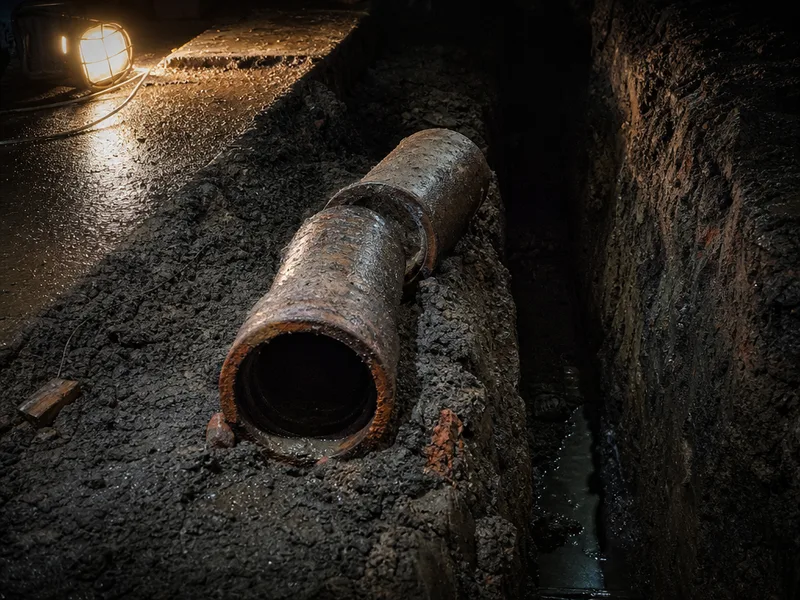
There is one sentence on the City of Evanston's website that changes how a homeowner here should think about a sewer quote, and it is not hidden. In accordance with Title 7, Chapter 13, Section 7, Paragraph (D) of the City Code, the property owner is responsible for the maintenance and repair of the building sewer or lateral including the pipe located in the parkway or street.
Read that twice, because the last four words are doing all the work. In this city the length of pipe you own does not stop at the property line, and it does not stop at the curb.
What that sentence costs, in practice
Every sewer lateral has the same three parts: the run under the building, the run under the yard and parkway, and the last stretch under the pavement to the main. What changes from one municipality to another is where responsibility for that pipe changes hands, and the last stretch is always the expensive one to reach. Pavement has to come up, traffic has to be managed, the trench has to be backfilled properly and the street has to be restored.
In Evanston that stretch is yours. There is no curb-line exception of the kind Oak Park's code carries, and no municipal program of the kind the City of Chicago publishes for drains broken under the public way.
That does not make repairs here worse. It makes the choice of method matter more, because the difference between reaching a defect through an access pit in the parkway and reaching it by cutting the street is a difference the property owner absorbs in full.
There is a second consequence that only shows up on the invoice. Work in a public street carries a permit and a restoration standard on top of the digging itself, and both of those costs sit with whoever is responsible for the pipe. In a city where the code says that is the property owner even under the pavement, the access point stops being a technical detail and becomes most of the price. Two quotes for the same defect can differ by thousands of dollars purely on where each contractor proposes to get at it, and neither of them is being dishonest. Ask any quote to say plainly where it opens the ground, how much surface it disturbs, and who is restoring what.
A combined system, and what the City says about its age
Evanston is unusual among these suburbs in a second way. The entire city is served by a combined sewer system, which carries sanitary waste and storm water in the same pipes, and the City describes the majority of that system as 80 to over 100 years old. It also publishes a figure that explains a lot of what homeowners experience in a storm: over 60 percent of the 144 miles of combined sewer is 12 inches in diameter or smaller.
The City has spent heavily on the public half of that problem. Its Long Range Sewer Improvement Program was constructed between 1991 and 2008 at a cost of approximately $210 million, adding 9 miles of shallow tunnels between 60 and 120 inches in diameter and 43 miles of sewer mains, all of it discharging into the MWRD deep tunnel that the City describes as 22 feet across and roughly 250 feet down in bedrock. The program won an Illinois Section award from the American Society of Civil Engineers in 2009.
None of that money reaches your lateral. It is worth knowing about anyway, because it separates two problems that look identical from a basement floor. A system at capacity during a downpour is a public matter and the relief sewers were built for it. A pipe that blocks in dry weather, or that rods clear and closes again a few months later, is a private one and the code says whose.
What a camera is actually settling here
Four readings decide the job, and only one of them is about cost.
The first is material. Under housing of this age the run is usually vitrified clay in short jointed sections, with cast iron under the slab. The second is shape, because a pipe that is cracked but still round can take a liner and one that has gone oval cannot. The third is fall, which shows on the video as standing water sitting in one place and which no trenchless method corrects, since both of them follow the line already in the ground. The fourth is position, and in Evanston position tells you how much pavement stands between a defect and a shovel.
A sewer camera inspection produces all four in one visit, and the recording is worth having in your own hands afterwards. A summary that says the line is in poor condition is an opinion. A video with a footage counter running is evidence, and it keeps working after the person who recorded it has moved on.
Which repair an Evanston line tends to be a case for
Sort the options here by how much ground each one opens, because that is the variable the code has made expensive. Sewer pipe lining opens the least. The liner goes in through an existing cleanout and cures against the inside of the old pipe, so a defect out under the pavement can be dealt with from inside the building. It needs a pipe that is cracked and rooted but still holding its round shape. Pipe bursting opens two pits and nothing in between, which is the answer when the pipe has collapsed or gone oval and a liner has nothing to line. Sewer line repair opens the ground directly over one failed section, and where the rest of the run is sound that is both the cheapest and the most honest quote. The four are set side by side on the services page, and what none of them can do is on the page about what trenchless work cannot fix.
Where Evanston sits among its neighbors
Skokie shares Evanston's western border and takes a different line again: the lateral is private there too, but the Village runs a narrow assistance program for repairs above a threshold when the main is deep and under a wide arterial. Ten miles southwest, Oak Park stops the owner's responsibility at the curb. The city those suburbs surround has its own program, which is described on the page about trenchless sewer repair across Chicago.
Five sets of rules inside one metropolitan area is not a quirk. It is the reason a quote that was accurate for a friend in another suburb may be the wrong shape for your address.
This is the same drawing as the one on the Oak Park page and it deliberately reads differently, because the rule it draws is different. Oak Park stops the owner's stretch at the curb line. Chicago may repair a private drain broken under the public way. Evanston's code names the parkway and the street and assigns both to the property owner.
What the City of Evanston publishes about its sewers and yours
The City spent $210 million on the public half of this system. The private half is still yours.
| What | What the City publishes | Published by |
|---|---|---|
| Who maintains and repairs the lateral | In accordance with Title 7, Chapter 13, Section 7, Paragraph (D) of the City Code, the property owner is responsible for the maintenance and repair of the building sewer or lateral including the pipe located in the parkway or street | City of Evanston, Sewer Systems |
| What kind of system the lateral connects to | The entire City is served by the combined sewer system, and the majority of the system is 80 to over 100 years old | City of Evanston, Combined Sewer System |
| How much of that system is small pipe | Over 60% of the 144 miles of the combined sewer system is comprised of 12-inch diameter or smaller pipes | City of Evanston, Combined Sewer System |
| What the City built to relieve it | The Long Range Sewer Improvement Program was constructed between 1991 and 2008 and cost approximately $210 million, adding 9 miles of shallow tunnels 60 to 120 inches in diameter and 43 miles of sewer mains | City of Evanston, Sewer Systems |
| Where the overflow goes | Evanston's relief sewer system discharges to the MWRD deep tunnel system, described by the City as 22 feet in diameter and approximately 250 feet deep in bed rock | City of Evanston, Sewer Systems |
The $210 million figure is for the City's relief sewers, which are public infrastructure. It is not a repair fund and no part of it reaches a private lateral. It is in the table because the contrast is the point: the public half of this system has had two decades of investment and the pipe from your house to it has had none unless you paid for it.
What Evanston homeowners want to know about a failing lateral
- Is the sewer pipe under the street in Evanston mine or the City's?
The City answers this in its own words on its own site: in accordance with Title 7, Chapter 13, Section 7, Paragraph (D) of the City Code, the property owner is responsible for the maintenance and repair of the building sewer or lateral including the pipe located in the parkway or street. That is unusually plain, and it is the opposite of what a neighbor in the city may have told you about a break under the public way. Rules stop at municipal boundaries, and this one is Evanston's.
- Why does that make trenchless work more attractive here than elsewhere?
Because the stretch you are responsible for includes the part that is hardest to dig. Reaching a defect under a public street means pavement removal, traffic control, backfill and restoration, and the property owner is carrying it. A method that reaches the same pipe from an access point in the yard or the parkway avoids most of that. It is not automatic. The pipe has to be in a condition that a liner or a bursting head can work with, and the video is what tells you.
- My basement floods when it rains hard. Is my lateral broken?
Not necessarily, and Evanston is a place where the distinction matters. The entire city is on a combined sewer system that carries sewage and storm water in the same pipes, the City says the majority of it is 80 to over 100 years old, and over 60 percent of its 144 miles is 12 inches or smaller. A system like that can be full during a storm without anything being wrong at your property. A line that backs up in dry weather, or that rods clear and blocks again within a few months, is a different signal and points at the pipe.
- Does Evanston's relief sewer project help with my sewer line?
No, and it is worth being clear about why. The Long Range Sewer Improvement Program was built between 1991 and 2008 at a cost of about $210 million, and it added 9 miles of shallow tunnel and 43 miles of mains that discharge to the MWRD deep tunnel. All of that is public infrastructure meant to keep the system from surcharging. None of it is a fund for private laterals, and the code paragraph above says who owns those.
- How old is the pipe likely to be under an Evanston house?
The City puts the age of the majority of the sewer system at 80 to over 100 years, and a lateral is usually the age of the building it drains. In practice that means vitrified clay in jointed sections under most of the older housing stock, with cast iron under the slab, and the failure modes follow the material: roots at the joints, cracked hubs, and sections that have dropped out of line with each other. A camera run is what turns that from a guess into a reading.
- What should I ask for before agreeing to any sewer work here?
The recording, the footage at which each defect appears, and a plain statement of what the pipe is made of and whether it still holds its shape. Those three answers decide whether you are looking at one section of repair, a full-length rehabilitation, or nothing yet. On a page like this site's guide to trenchless sewer repair in Chicago the same rule applies everywhere, but in Evanston it carries more weight, because the pipe you are being quoted on may run under a public street that you are nonetheless responsible for.
Find out how far the trouble is before you price a dig
In Evanston the length of pipe you are responsible for runs under the parkway and under the street, so where the defect sits changes the job completely. Send the address and what the drain is doing.
Free, written, and no obligation. We answer requests the same day.