Sewer pipe lining in Chicago, IL
Sewer pipe lining in Chicago puts a resin-saturated tube inside the pipe you already have and cures it in place, so the old clay becomes the mold for a new one. It is the cheapest trenchless answer when it fits, and there are four conditions that rule a line out entirely.
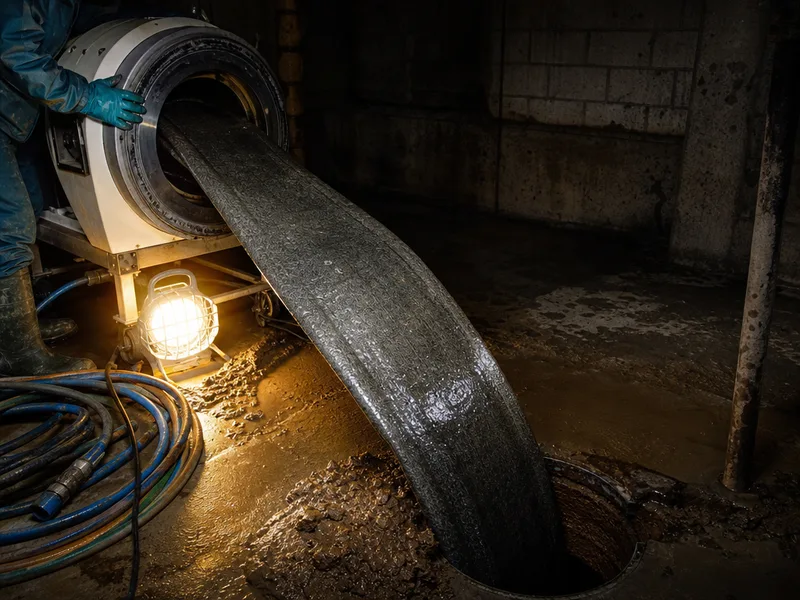
Cured in place pipe lining, or CIPP, is the one trenchless method that keeps your existing pipe. A felt or fiberglass tube is saturated with resin, pulled or inverted into the sewer line, pressed against the old wall and cured hard. When it sets you have a jointless pipe inside a jointed one, installed through a cleanout in the basement floor with no trench across the room.
Sewer pipe lining in Chicago is the right answer more often than it is the available one, and the difference between those two is what this page is about.
What a cured in place liner actually is
The method has a published standard, and the standard is what a quote can be measured against. ASTM F1216 covers the inversion method, where water or air pressure turns the resin tube inside out along the pipe. ASTM F1743 covers the pulled-in-place version. Both describe how the tube is wetted out, how it is cured and what the finished liner has to demonstrate.
A contractor working to either one is doing a specified job. A contractor who cannot tell you which one is describing something else.
When a Chicago sewer line can be lined, and when it cannot
Four conditions rule it out, and any of them on its own is enough:
- The pipe has collapsed. A liner needs a host to be cured against. Where the wall is gone there is nothing to press it into.
- The line is badly out of round or offset at the joints. A liner follows the shape it finds. A sharp offset becomes a lip inside the new pipe.
- The fall is wrong. Lining a back-pitched sewer produces a smooth pipe that still holds water in the same place.
- The line is undersized for the building. Lining takes a little diameter away, so a line that was already marginal is the wrong candidate.
Clay tile with root intrusion at otherwise sound joints is close to the ideal case, and that describes a great deal of Chicago's pre-war housing stock. Cast iron that has rusted through at the bottom but is holding its shape is the other common one.
What lining does not do
It does not move the pipe. It does not change where the line runs, how deep it sits or the grade it was laid at in the first place. It does not repair a connection the liner has to be cut open for afterwards, and every branch running into the lined section has to be reinstated with a cutter once the resin has cured.
None of that is an argument against lining. It is the list a quote should already have addressed, and on most competitor pages the list is missing because every one of them sells the method. Trenchless sewer repair in Chicago is worth having precisely because it is not universal, and the lines it does not suit are handled by pipe bursting or by a conventional sewer line repair.
The certification is checkable, and that is the point
NASSCO runs the training the industry inspects CIPP installations against, and it publishes a directory of certified professionals that anyone can search by name. Illinois requires a license to work on a plumbing system at all, and the Illinois Department of Public Health says it licenses about 8,900 plumbers and 2,000 apprentices, each of whom passes a state exam after four to six years working as a licensed apprentice.
That is a fact about the trade, not a claim about anybody. It matters here because it means you never have to take a badge on a website at face value. Whoever quotes your lining job, ask for the name on the certificate and look it up. If the site you are reading it on will not give you a name, that is also information.
Where the words on a pipe lining quote come from
Lining is a standards-driven job. These are the documents the standards live in, and none of them is ours.
| What | The published standard | Published by |
|---|---|---|
| Cured in place pipe, installed by inversion | ASTM F1216, Standard Practice for Rehabilitation of Existing Pipelines and Conduits by the Inversion and Curing of a Resin-Impregnated Tube | ASTM International |
| Cured in place pipe, pulled into place | ASTM F1743, Standard Practice for Rehabilitation of Existing Pipelines and Conduits by Pulled-in-Place Installation of Cured-in-Place Thermosetting Resin Pipe (CIPP) | ASTM International |
| Training for the people who inspect a CIPP installation | NASSCO ITCP for cured in place pipe, with recertification required every three years | NASSCO |
| Who may legally do plumbing work in Illinois | Anyone who plans, installs, alters, extends, repairs or maintains a plumbing system must be licensed. IDPH licenses roughly 8,900 plumbers and 2,000 apprentices | Illinois Department of Public Health |
NASSCO publishes a public directory of certified professionals, and the City of Chicago publishes a register of licensed plumbing contractors. Both are searchable by anyone. Ask whoever quotes your job for the name on the certificate and check it yourself rather than taking a logo on a website for it.
Pipe lining questions Chicago homeowners ask
- How much does it cost to have a sewer pipe lined?
We publish no figure of our own, because there is no job history behind this site to average and an invented range is worse than no range. What decides it is footage, diameter, how many branch connections have to be reinstated, and whether an access pit is needed at one end. Lining is normally cheaper than open-cut replacement on the same run and more expensive than a spot repair on a short one. Our guide to what sewer work costs in Chicago covers what moves the number.
- Is relining a sewer pipe worth it?
On a cracked but round clay line under a finished basement floor, it usually is, because the alternative is breaking and repouring the slab. On a line that has already collapsed it cannot be done at all. And where the fall is wrong, lining is money spent on the wrong problem, since the liner takes the shape and the slope of whatever it is cured inside. The honest version of this answer is in our post on what trenchless repair cannot fix.
- How long does a CIPP liner last?
Fifty years is the number the industry quotes, and we are not going to repeat it as though we had checked it. It is a design life, which is an engineering assumption rather than a measurement, and we did not find a publisher for it that this site would cite. CIPP has only been in wide residential use since the 1980s, so nobody yet has a fifty-year-old liner in Chicago ground to point at. What you can check is the standard the liner is installed to, which is in the table above.
- Does a liner make the pipe narrower?
Yes. A liner is a real wall thickness inside the existing pipe, so a 6 inch line comes back slightly smaller than 6 inches. In practice the new surface is smooth where the old clay was rough and jointed, so flow is usually better rather than worse. It matters when the line was already undersized for the building, and that is a case for pipe bursting, which replaces the pipe with one the same size or larger.
- Is pipe lining allowed in the City of Chicago?
Chicago permits and inspects plumbing work under its own municipal code, and the City's private drain process requires a contractor to obtain a permit from the Department of Water Management before rodding or videotaping a private drain, then to schedule a City inspector. So the answer for a specific address is settled by the permit for that job, not by a claim on any contractor's website. We looked for the code provision itself and could not read it from a public source we would cite here, so we are not going to paraphrase somebody else's version of it. Ask whoever quotes your work to show you the permit they will be pulling.
- What do you need from me to say whether my line can be lined?
The property address, the age of the building, and a photograph of the cleanout if there is one you can reach. A camera run settles it properly, and that is the sewer camera inspection we would book first. If the video shows a collapse, a bad fall or a length of missing pipe, you get told that lining is off the table rather than a quote for a liner that would not hold.
Ask whether your line can be lined at all
Half the value of an inspection is being told no. Send the address and what the drain is doing, and if the pipe is past lining you will hear that instead of a quote for it.
Free, written, and no obligation. We answer requests the same day.