Pipe bursting in Chicago, IL
Pipe bursting replaces a Chicago sewer line without opening the ground along it. A splitting head is winched through the old pipe, breaks it outward into the surrounding soil, and pulls a new fused line in behind itself. It needs two pits and it is the answer when there is nothing left to line.
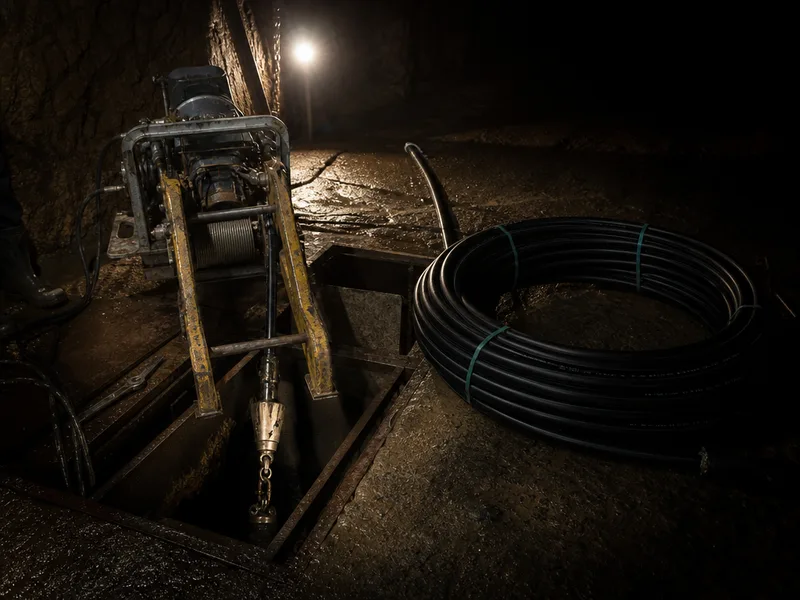
Pipe bursting is the trenchless method for a sewer line that is past saving. Instead of curing a liner inside the old pipe, it destroys the old pipe and puts a new one where it was. A steel cable is run through the line, a splitting head is pulled back along it under hydraulic force, and the fragments of the old clay, cast iron or Orangeburg are pushed out into the surrounding soil while the replacement follows in behind.
The pipe going in is normally HDPE, heat-fused into a single continuous length before it leaves the surface. That matters more in this city than the method does. A fused line has no joints along its length, and joints are where a Chicago lateral fails.
Clay and Orangeburg, which is why this page exists separately
The two failures that most often rule out lining are the two that most often turn up here.
Vitrified clay was standard on Chicago laterals for the first half of the twentieth century. It is laid in short sections, and the mortared joints between them take root intrusion and settlement until the line is a series of steps. Where the offsets are bad enough, there is no round host pipe for a liner to be cured against.
Orangeburg is the post-war one. It is a rolled fiber pipe bound with hot pitch, cheap and quick to lay when the housing went up, and its failure mode is not a crack. It goes oval under the weight of the ground, slowly, until the top of the pipe meets the bottom. A liner needs a shape to take, and an Orangeburg line that has gone flat has not got one left to give it.
What the job costs you above ground
Two pits, not a trench. One at the building end, usually close to the foundation wall or an existing cleanout, and one at the far end near the parkway or the sidewalk. Everything between them stays undisturbed, which on a standard Chicago lot is most of the front garden and all of the walk.
That is the honest version of the trenchless claim. Nobody opens the whole run, but two holes still come out of the ground, and the saving only means something when the ground in between is expensive to put back. Under a finished basement slab, or beneath mature parkway trees, it usually is. Across an open lawn it is a closer call, and that is a conversation to have before the work is booked rather than after.
The Illinois rule most Chicago sewer pages never mention
Bursting displaces soil sideways along the whole run, so what else is buried next to the line stops being a detail. Illinois handles that through JULIE, the state's one-call service. The Underground Utility Facilities Damage Prevention Act requires the locate before the excavation, the Illinois Commerce Commission enforces it, and the penalties run to $5,000 per violation.
There is a second rule, newer, and it applies directly to what bursting does.
Illinois now requires that any service lateral which is completely replaced, or newly installed, be made locatable by electromagnetic or other equally effective means. Pipe bursting is a complete replacement. The new line should therefore go in with a tracer wire, marker tape or an equivalent along it.
A tracer wire is a requirement on the job rather than an upsell, and it is worth asking about by name, because the reason the rule exists is the situation you are already in. JULIE's own explanation says clay and Orangeburg laterals cannot be found with electromagnetic locating equipment at all. The pipe being replaced today is invisible to a locator, which is exactly why the one replacing it must not be.
Whether the line under your lot is a bursting job, a lining job or a repair of one section is decided by video, not by a method somebody prefers to sell. The full set of options is on the page about trenchless sewer repair in Chicago, and the cases where no trenchless method is the right one are set out in what trenchless repair cannot fix.
The rules a Chicago pipe bursting job runs under
Bursting is regulated work in Illinois before it is plumbing work. Every row below is published by somebody you can check.
| What | What is published | Published by |
|---|---|---|
| Locating buried utilities before anyone digs | Required by the Illinois Underground Utility Facilities Damage Prevention Act, enforced by the Illinois Commerce Commission, with penalties of $1,000, $2,500 or $5,000 depending on the violation | JULIE, Illinois 811 |
| A sewer lateral that is completely replaced | Illinois law requires the new lateral to be made locatable by electromagnetic or other equally effective means | JULIE, Illinois 811 |
| Why the old line could not be found in the first place | Laterals of clay, Orangeburg, PVC, polyethylene or rolled black plastic cannot be found with electromagnetic pipe and cable locating equipment | JULIE, Illinois 811 |
| Joining the new polyethylene pipe into one length | ASTM F2620, Standard Practice for Heat Fusion Joining of Polyethylene Pipe and Fittings | ASTM International |
JULIE describes the sewer lateral as predominantly a private line: the municipality owns and maintains the sewer main and the manholes, and the pipe running from its end point to the building wall is the property owner's. That ownership split is the same one the City of Chicago's private drain program is written around.
Pipe bursting questions Chicago homeowners ask
- What is pipe bursting?
A cable is threaded through the existing sewer line from a pit at one end to a pit at the other. A cone-shaped bursting head is pulled back along it under hydraulic force, splitting the old pipe outward into the soil while the new pipe follows in the space it leaves. The new line is normally HDPE, heat-fused into one continuous length before it goes in, so the finished pipe has no joints for roots to find.
- What is the typical cost of pipe bursting?
No figure of ours, for the same reason as everywhere else on this site: there is no job history behind it to average. Bursting costs more than lining on the same run and less than trenching the whole length, and the numbers that move it are footage, depth, how deep the two pits have to go, and what has to be restored afterwards. Our guide to what sewer work costs in Chicago sets out what is actually being priced.
- Do you still have to dig?
Yes, twice. There is a launch pit and a receiving pit, usually one at the building and one near the parkway or the sidewalk. What you do not get is a trench along the whole run, which on a Chicago lot is the difference between two square holes and a channel through the front garden, the walk and whatever is planted over it.
- Can pipe bursting replace Orangeburg pipe?
It is one of the better cases for it. Orangeburg deforms into an oval instead of cracking, so it usually fails the shape test that lining depends on, and it breaks up easily under a bursting head. It is also, as JULIE points out, one of the materials that cannot be found with electromagnetic locating equipment, which is a reason to expect an inspection before anyone quotes a price on a house of that era.
- When is bursting the wrong method?
When the fall is wrong, because the new pipe follows the old path and inherits the same slope. When the line runs close to other buried services, since bursting displaces soil sideways and something at the same depth a foot away is a real risk. When the run has a sharp bend the head cannot negotiate. And where the pits themselves would have to go through a slab or a structure, at which point the saving disappears.
- How do I find out whether my line needs bursting?
Book a sewer camera inspection first and read the video. A line that is cracked but round is a lining job. A line that is collapsed, crushed, oval or undersized is a bursting job. Send the address and the age of the building and you will get a written estimate covering the inspection and the likely method, with the method named rather than left open.
Find out whether the old line is worth keeping
Bursting is the expensive answer and it is sometimes the only one. A camera run tells you which case you are in, and the estimate that follows is written against the video rather than against a guess.
Free, written, and no obligation. We answer requests the same day.