The disadvantages of trenchless sewer repair
Almost every page written about the disadvantages of trenchless sewer repair is written by somebody who installs it. This one lists what the method takes from you even when it works, what you have no way of checking afterwards, and the cases where opening the ground is the better answer.
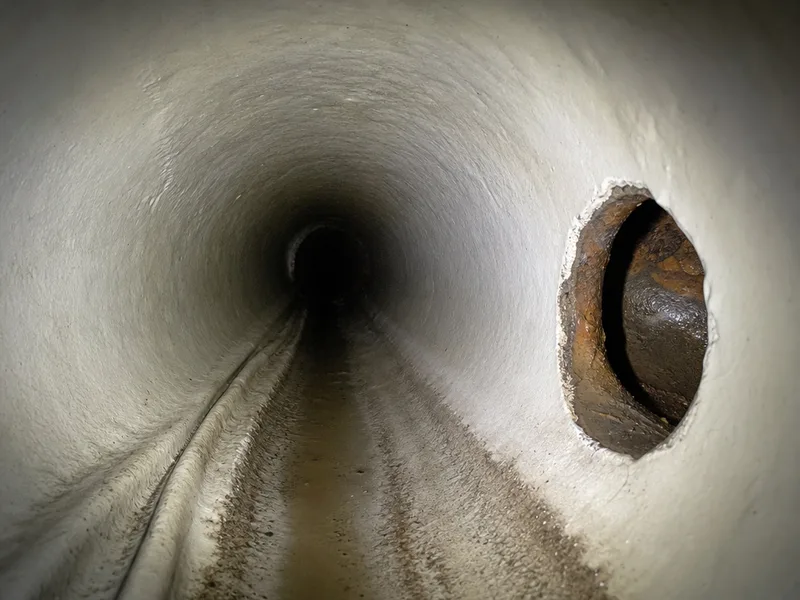
Trenchless repair is the right answer on a great many sewer lines, and this site exists because of it. That is exactly why the case against it is worth writing down properly: every page that ranks for this question is published by a company that installs the method, and a list of downsides written by the seller tends to be a list of things that are not really downsides.
Some of what is below is about the lines the method cannot fix. Most of it is about what the method costs you on the lines where it works perfectly.
What are the disadvantages of trenchless sewer repair?
They fall into four groups, and only the first one gets much coverage.
There are the lines it cannot fix at all. That list is the shortest, and it is the one most competitor pages do at least mention in passing. There are the things it takes from you in exchange for not opening the ground. There is a verification problem, which is the serious one: the finished work is buried, so you cannot look at it. And there is what the process itself brings onto the property while it is happening.
The cases where no trenchless method applies are set out under what trenchless sewer repair cannot fix on our home page, and they come down to shape, grade and size. The rest of this page is the other three groups, which almost nobody publishes.
What are the disadvantages of CIPP lining?
Lining is the cheapest trenchless answer and it is the one with the most fine print.
The new pipe is built inside the old one, so every branch that joins the lined section is sealed over as the resin cures and has to be cut back open afterwards with a robotic cutter. That reinstatement is a separate operation with its own failure modes: cut short, cut off center, or missed entirely on a connection nobody knew was there. On a single family lateral there may be only one or two. On an older two-flat with a converted basement there can be several, and the count is a fair question to ask before the price is agreed.
The liner also takes the shape it is cured against, faults included. A joint that has settled into a small step sets as a ridge in the finished wall, and solids catch on it from then on.
Then there is the resin. A polyester or vinyl ester CIPP liner is cross-linked with styrene, and the cure is a chemical process happening a few feet under the building. That has practical consequences for the people inside it, and they are covered further down this page, because the trade's own standards body publishes guidance on them and almost no contractor page repeats it.
Where any of that rules the method out, the alternatives are pipe bursting or an open replacement of the failed section.
What are the disadvantages of trenchless pipe replacement?
Bursting has the opposite profile. It is the more capable method and it is the more violent one.
The old pipe is not removed. It is split outward and left in the ground as fragments packed around the new line. That is fine in itself, and it is one reason the ground over a long run can settle unevenly afterwards. The head also displaces soil sideways as it travels, so anything buried at a similar depth close to the line is exposed to that force. Gas, water and communications are the usual neighbors in a Chicago parkway, and they are the reason the locate is not paperwork.
The two access pits have to go somewhere, and on a typical lot the far one lands at or near the parkway or the walk. That puts part of the job in the public way, which brings permits, an inspection and restoration of whatever was opened into a price that a homeowner was thinking of as a plumbing bill. None of that is hidden from you and none of it is a trick. It is just not what people picture when they are told that nothing gets dug up.
What is the life expectancy of trenchless pipe lining?
There is a standard answer to this and it is half a century. We do not repeat it as a figure of ours, because no publisher we would cite here turned out to have one. A design life is also an expectation set for a material under stated conditions, which is a different kind of statement from a measurement taken under your house.
What is checkable is different and more useful. The installation is done to a published ASTM practice, so a quote can name which one. The cure has conditions, so the contractor can be asked what they were and whether they were logged. And the finished liner can be filmed, coded and compared against the video taken before the work started.
That final recording is the single most valuable thing you can ask for and the one most often skipped. It is the only evidence you will ever have about the wall of a pipe you are not going to see again. Getting the first video is covered under sewer camera inspection; ask for the second one in the same conversation, in writing, before the resin is ordered.
The part nobody mentions: the cure is a chemical process
NASSCO is the trade body whose codes the whole sewer inspection industry writes its reports against, and it publishes a guideline on the safe use and handling of styrene-based resins in CIPP. That guideline says residents should be informed of the installation schedule and what to expect, and advised to make sure their sewer traps are filled with water and in a proper state of repair. Where traps are dry, damaged or absent, it asks that rooms with floor drains be ventilated to the outside while the work is happening.
The reason is straightforward. A trap full of water is a seal. An empty floor drain in a basement laundry is an open pipe between the room and the line being cured, and styrene is noticeable at concentrations far below the levels the guideline is concerned with, so a strong smell tells you the seal is missing rather than telling you how much is present.
The guideline exists because the question was asked from outside the industry first. Purdue University's engineering school has run a research group on CIPP emissions since 2016 and reported that chemicals can be emitted into the environment and enter nearby buildings. NASSCO commissioned its own multi-phase study in response and reports that styrene was the only compound to exceed regulatory thresholds in part of the second phase of measurements.
We are not telling you to avoid lining over this. The honest summary is that a mature method has a known nuisance with published handling guidance, and that almost nobody selling it to homeowners mentions the guidance. Ask which cure method is being used, ask for the date, and run water into every floor drain in the building that morning.
Is trenchless sewer repair worth it?
On clay that is cracked but still round, sitting under a finished basement floor, a public walk or a tree worth keeping, it usually is and it is not close.
Across an open lawn with nothing over the run, on a line whose fall is already wrong, or on a job where nobody will commit to filming the result, it buys you a good deal less than the brochure suggests. Which is why the camera goes in before anybody picks a method.
What the trade's own standards body publishes about the resin
None of this comes from a competitor. Two of the three rows are published by NASSCO, whose standards the trade writes its own inspection reports against.
| What | What is published | Published by |
|---|---|---|
| What the resin is cross-linked with, and how easily it is noticed | Styrene is described as the ideal monomer for cross-linking the polyester and vinyl ester resins used in CIPP. Its odor can be detected at concentrations as low as 0.16 ppm, or as low as 0.1 ppm, depending on the person | NASSCO, Guideline for the Safe Use and Handling of Styrene-Based Resins in CIPP, April 2023 |
| What NASSCO says residents should be told and asked to do | Residents and homeowners should be informed of the CIPP installation schedule and what to expect, and advised to ensure their sewer traps are filled with water and in a proper state of repair. Where traps are dry, damaged or absent, the rooms with floor drains should be ventilated to the outside during installation | NASSCO, Guideline for the Safe Use and Handling of Styrene-Based Resins in CIPP, April 2023 |
| Why the guideline exists at all | Studies by Purdue University and others raised the question of possible hazards to workers and the public from styrene released at steam cured CIPP sites, and found other volatile organic compounds in the exhaust. NASSCO commissioned its own multi-phase research in response, and reports that styrene was the only compound to exceed regulatory thresholds in a portion of the Phase 2 measurements | NASSCO, Styrene and CIPP |
| Who is still researching it independently | Purdue University's College of Engineering has run a CIPP research group since 2016 examining chemical air emissions from the method, and states that chemicals can be emitted into the environment and enter nearby buildings | Purdue University, CIPP Solutions Group |
We publish this because it is the sort of thing a homeowner finds out on the day rather than in the quote, and because it comes with a practical instruction anybody can follow. It is not a reason to avoid lining. It is a reason to ask which cure method is being used and when, and to put water down every floor drain in the building the morning it happens.
The questions a company selling trenchless work tends not to answer
- Will I smell anything while a liner is curing?
You may. Styrene has a strong chemical smell and NASSCO's own guideline notes it can be detected at very low concentrations, so noticing it says little about how much of it there is. The guideline asks contractors to tell residents the schedule in advance and to advise them to fill their sewer traps with water and keep them in good repair, because a dry or missing trap is an open path from the sewer into the room. Running water down every floor drain the morning of the work is a two minute job that solves most of it.
- Can you still rod a lined pipe?
Yes, and the smooth wall makes it easier than it was. What changes is that a cutting head being run aggressively through a liner is working on a wall a few millimetres thick with nothing structural behind it in places. Tell whoever rods it that the line is lined, and say where the reinstated branches are if you know. That is one more reason to keep the recording of the installation somewhere you can find it in ten years.
- Can a trenchless repair fail?
It can, and the failures are specific rather than mysterious. A liner can cure with a fold or a wrinkle in the wall, which catches solids exactly where the old joints used to. A branch reinstatement can be cut short or off center, leaving a partly blocked connection. A bursting head can wander at a bad joint. None of these announce themselves in the basement on the day, which is why the video taken after the work is the only real acceptance test you have.
- When is digging the better answer?
When the fall is wrong, because no trenchless method re-lays a pipe to a new grade. When the line is undersized for what the building has become. Where the pipe turns hard enough that neither a liner nor a bursting head will follow it, or where a length has already caved in and filled. And sometimes on cost alone: across an open lawn, with nothing valuable over the run, the two answers sit much closer together than the marketing suggests.
- What should I ask before agreeing to a liner or a burst?
Four things. Which cure method, and on what day. Where the priced run starts and stops. How many branch connections the liner will seal over, and how each one gets checked once it is cut back open. And whether the recording made after the work is finished comes to you. If the last one is a problem, that is your answer to the other three.
- How would I know the method being sold to me is the wrong one?
By watching the same video the contractor watched. A liner has to cure against something that is still round, so standing water that never drains, an oval section or a length of missing wall are all visible reasons the quote in front of you does not fit the pipe it was written for. A camera inspection is what produces that evidence, and asking here gets you a written estimate set against it. Introductions are the whole of what this site sells, no plumbing license sits behind it, and nothing here gets better for us if the answer turns out to be lining.
Ask whether the method being quoted is the right one
The video answers that and nothing else does. Ask here and a sewer contractor reads it with you. Where the recording rules a method out, that is what comes back, and it costs you the same as a quote would have.
Free, written, and no obligation. We answer requests the same day.