Sewer camera inspection in Chicago, IL
A sewer camera inspection in Chicago is a camera head on a push cable, run from a cleanout out toward the City main while you watch the screen. It is how a break gets proven rather than guessed at, and in this city it is also the step the City requires before it will review a private drain repair.
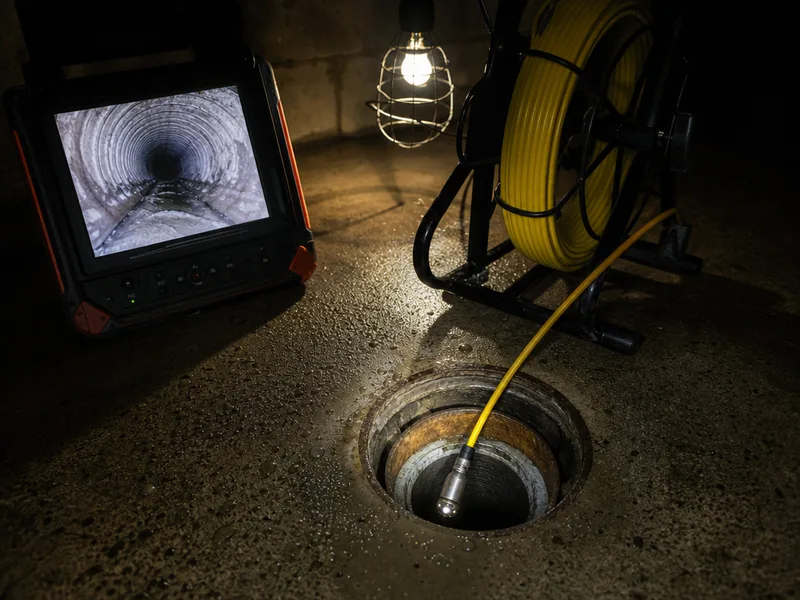
A sewer camera inspection is a camera head on a push cable, fed into the line at a cleanout and run out toward the City main while the reel counts the footage. You watch the screen as it goes. What comes back is not an opinion about your pipe, it is your pipe.
That distinction is the whole argument for doing this first. Everything else on this site is a method, and every method depends on facts about the line that only a camera supplies: what the pipe is made of, whether it still holds its shape, how far along the defect sits and which side of a boundary it falls on.
What the camera is actually looking for
Four things, and each one sends the job somewhere different.
The material comes first, because vitrified clay in short jointed sections, cast iron under the slab and post-war Orangeburg each fail in their own way. Then the shape, since a round pipe can be lined and an oval or collapsed one cannot. Then the fall, which shows up as standing water sitting in one place on the video: a low spot is not fixed by any trenchless method, because both of them follow the line already in the ground.
Last is position, and in Chicago that is the reading that decides who pays.
What a sewer line inspection finds that a rodding does not
Sewer rodding clears a line. It tells you the blockage moved and nothing about why it was there. A line that rods open easily and blocks again in four months has a defect the rod is passing straight through, and the second call costs what the first one did.
Rodding still has its place. The point is that a camera should follow one on any line that has backed up more than once, and the City's own private drain process pairs them for the same reason: the contractor rods and videotapes, and an inspector watches.
The one Chicago fact that makes this the first call rather than an add-on
Everywhere else, a sewer camera inspection is a diagnostic. In Chicago it is also the gate to a repair somebody else may pay for.
The City of Chicago runs a private drain program. Where a private drain is broken under the public way, which the City defines as the area from the city sidewalk to the center of the street, it may repair that section for a residential building of up to and including four units at no cost to the property owner. The City sets two conditions on it. A licensed sewer contractor must be hired to rod and/or make a video inspection of the drain line, and that contractor must schedule a review by a City sewer inspector.
Read that as a description of the process, because that is what it is. The requirement belongs to the City, and so does the register of licensed plumbing contractors, which anyone can search. We are a lead matching service and we do not hold that license ourselves, so what we can honestly tell you is what the City asks for and what a request through this site actually does: it puts your address in front of a contractor who does hold one.
The 311 overview of the same program adds the part homeowners most often trip over. The contractor obtains a permit from the Department of Water Management to rod and videotape the drain, then books an inspector to be present while it happens, and hands that inspector the video. An inspection carried out without the permit and without the inspector is a perfectly good inspection, and it is not the one the program accepts.
The consequence is worth stating plainly. If the break turns out to be under the public way and the video was taken outside that process, the work has to be done again before the City will look at it. Book the camera run knowing which of the two you are asking for.
Why the footage counter is the number to write down
Chicago lots are deep and the boundary that decides who pays is a fixed distance along the run rather than a feature you can see on a screen. The video shows a crack at 46 feet; the sidewalk is where it is; the question of whether those two coincide is the entire difference between a bill and no bill.
That is also the reason to insist on getting the recording. A contractor's summary of a video is a claim. The video with the footage counter running in the corner is evidence, and it is evidence that keeps working after the person who took it has gone.
Where the defect turns out to be decides the rest: lining for a cracked but round pipe, pipe bursting where the pipe is gone, a single section of sewer line repair for one break in an otherwise sound run, or the City's own crew where the break is under the street. The whole set is on the page about trenchless sewer repair in Chicago, and how the program works start to finish is in the guide to the Chicago private drain program.
What the City requires before it will look at a private drain
Two of these are the City telling you what it needs. One is the City telling you what it will not do.
| What | What is published | Published by |
|---|---|---|
| What has to happen before a private drain review | A licensed sewer contractor is hired to rod and/or make a video inspection of the drain line, and that contractor schedules a review by a City sewer inspector | City of Chicago, Private Drain Repair |
| The permit the video is taken under | The contractor obtains a permit from the Department of Water Management to rod and videotape the private drain, then schedules a house drain inspector to attend, and provides that inspector with the video | City of Chicago 311, Private drains program overview |
| What the City's own sewer inspection request covers | Public sewer structures such as storm drains on or near the curb. The City says not to use it for a catch basin on private property, which is the owner's responsibility | City of Chicago 311, Sewer cleaning inspections |
| How inspection findings are coded across the industry | NASSCO's Pipeline Assessment Certification Program (PACP) and its Lateral Assessment Certification Program (LACP), with recertification required every three years | NASSCO |
| Who may work on a plumbing system in Illinois at all | A license is required to plan, install, alter, extend, repair or maintain one. IDPH says it licenses roughly 8,900 plumbers and 2,000 apprentices | Illinois Department of Public Health |
The City publishes a searchable register of licensed plumbing contractors, and NASSCO publishes a searchable directory of certified individuals. Both are open to anyone. A logo on a website is not either of those things.
The City's own process runs in that order: the contractor obtains a permit from the Department of Water Management to rod and videotape the drain, an inspector is scheduled to attend, and the video goes to that inspector. If the line clears by rodding, no City work follows. If it does not, the contractor and the City inspector together determine whether the break is on private property or in the public way.
Sewer camera inspection questions Chicago homeowners ask
- How much does it cost to run a camera through a sewer line?
We publish no price of our own anywhere on this site, and this page is no exception. A camera run is the small number in this trade and the repair is the large one, which is why an inspection quoted at nothing is usually not free of anything: it is bundled into the work that follows. Ask whether you get the recording either way. Our guide to what sewer work costs in Chicago covers what sits behind the figures.
- How do I prepare for a sewer camera inspection?
Clear access to the cleanout, which in most Chicago basements is a capped fitting in the floor near the front wall or beside the drain. If you do not know where it is, say so when you book rather than on the day, because a line with no reachable cleanout is a different job. Run no laundry for an hour or two beforehand, and have the age of the building to hand. If a previous contractor left you a video, keep it, because two recordings a few years apart tell you the rate of change.
- Is a sewer scope inspection worth it before buying a house?
On Chicago housing stock it is one of the cheapest pieces of information you can buy. A general home inspection does not include the buried lateral, and the lateral is the single most expensive thing that can be wrong with an older property here. A sewer scope inspection tells you which of clay, cast iron or Orangeburg is under the lot and what state it is in, before that becomes yours.
- What is NASSCO, and does it change my sewer report?
NASSCO is the trade body whose coding standards the industry writes inspection reports against. Its Pipeline Assessment Certification Program, PACP, gives every defect a code and a grade instead of an adjective, and its lateral program, LACP, does the same for the pipe from the building to the main. It matters because a coded report can be compared with the next one and with somebody else's. A report that reads "pipe in poor condition" cannot.
- Will the City inspect my sewer line for free?
Not the one under your house. The City's sewer cleaning inspection request is for public sewer structures, and 311 says outright not to use it for a catch basin on private property. What the City does do is send an inspector to attend the rodding and videotaping of a private drain under the private drain program, which is a different thing and starts with a contractor pulling a permit.
- What do I get at the end of a sewer camera inspection?
You should get the recording, a written statement of what was found, and the distance along the line at which it was found. That last one is what turns a video into a decision, because where the defect sits decides whether it is a lining job, a bursting job, one section of repair, or a case for the City. Ask for all three before the camera goes in, not after.
Get the line on video before anyone quotes a repair
The camera is the cheapest part of this and it decides everything after it. Send the address and what the drain is doing, and the inspection is what gets booked first.
Free, written, and no obligation. We answer requests the same day.